
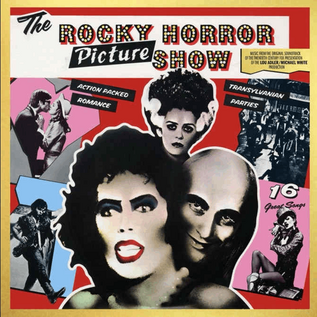
The Rocky Horror Picture Show, a movie I’ve probably seen, oh, I don’t know, 30 to 40 times—and I’m still not entirely sure what the hell is going on. Every rewatch feels like being invited to a dinner party where no one explains the theme until halfway through the entrée.
This isn’t just any cult film soundtrack—it’s the musical equivalent of being tickled by an alien in high heels. It’s camp, chaos, and charisma in one vinyl sleeve. And I’ll be walking you through the album track by track, picking apart every shriek, sax solo, and fishnet-flavored flourish. Because if you can’t overanalyze a glam rock Frankenstein musical in late October, when can you?
Science Fiction/Double Feature
This is where it all begins: disembodied lips, a slow crawl of opening credits, and Richard O’Brien whisper-singing his way through the B-movie graveyard of his youth. On the soundtrack, stripped of visuals, it becomes something else entirely—a love letter to atomic-age absurdity. It’s slow, dreamy, and just self-serious enough to make you wonder if you accidentally stumbled into an NPR special about laser guns.
There’s something charmingly fragile about this one. The strings sway like the soundtrack’s trying to take itself seriously, while that lonely saxophone weaves in with the energy of a guy who definitely brought his own smoke machine to the session. The production is thin, but it’s perfect—like it’s meant to be heard on a transistor radio buried under the seat of a ‘59 Chevy.
I’ve always felt the movie’s version drags a little, sure—the credits, the lips, the “is this going somewhere?” energy—but on vinyl, it’s weirdly hypnotic. It draws you into the tone of the album: sweet, off-kilter nostalgia with just a hint of menace. It’s not trying to be perfect; it’s just trying to be strange, and it nails that in the first two minutes.
Dammit Janet
If “Science Fiction/Double Feature” is the curtain rise, “Dammit Janet” is the aggressively heterosexual tone-setter before everything goes delightfully off the rails. This is the song equivalent of a Norman Rockwell painting that suddenly catches fire halfway through. Brad and Janet are pure 1950s sincerity—he’s got a ring, she’s got the personality of a mannequin who just discovered modesty, and together they radiate the erotic energy of a Sears catalog.
Barry Bostwick and Susan Sarandon sell it, though. Their voices are so squeaky-clean, you can hear the starch in their khakis. The church bells chime, the harmonies sparkle, and you can practically smell the casserole cooling on the windowsill. Every “Dammit, Janet” feels like it’s fighting the urge to turn into a toothpaste jingle.
But that’s the brilliance. The song is supposed to be unbearable—it’s the setup for the greatest tonal ambush in musical history. Behind them, you’ve got the wedding party transforming the scene into a funeral, and it’s like the movie’s quietly whispering, “Oh, you think this is wholesome? Just wait till the corsets show up.”
Having seen the movie so many times, I can’t hear this track without mentally watching the entire world tilt behind them—the faint suggestion that something unholy is brewing in that church basement. On the album, it’s all sugar and no teeth yet. But you can feel the chaos revving up, one “Dammit, Janet” at a time.
Over at the Frankenstein Place
By the time we hit “Over at the Frankenstein Place,” Brad and Janet have gone from “hopelessly devoted” to “hopelessly lost.” The rain’s coming down, the car’s sputtering like it’s on life support, and suddenly—boom—there it is: a castle on the hill that screams don’t go in there. Naturally, they go in there.
On vinyl, this one hits differently. The movie cuts in and out of dialogue and reaction shots, but the album track gives you just the right amount of eerie stillness. Susan Sarandon opens with that fragile, breathy delivery, and for a second, you can actually feel Janet’s fear and curiosity breaking through the bubblegum. Then Barry Bostwick joins in, his voice steady and pure, like the only Boy Scout left in a world gone glam.
And then—Richard O’Brien slides in like a vampire uncle crashing karaoke night. The harmonies get thick, the atmosphere turns electric, and suddenly this cute lost-couple number becomes something else entirely: gothic, cinematic, slightly horny. The background vocals are so lush they sound like they were recorded in a cathedral made of vinyl and eyeliner.
This is where you realize: it’s not just a parody. It’s a full-blown rock opera. The mix is rich, the instrumentation is alive, and even without the visuals, you can feel the lightning strikes. If you close your eyes, you can see the flicker of the castle lights and that first glimpse of a man in heels waiting to change your life forever.
Time Warp
Okay, here it is—the one that broke containment and invaded every wedding, Halloween party, and late-night bar DJ set on Earth. “The Time Warp.” The anthem of the damned, the joyful nonsense chant of a thousand fishnets.
This track doesn’t just begin; it erupts. Richard O’Brien comes barreling in, shouting his lines like a man possessed—and maybe he is. He’s the mad scientist hype man none of us knew we needed. Then Magenta steps up, dripping with sultry menace, and Columbia screeches her verse like someone spiked her cotton candy with Red Bull and glitter. It’s chaos, but the kind of chaos you want tattooed on your subconscious.
Each verse piles on more energy until the chorus is this unstoppable wall of sound—guitars punching, drums rolling, voices overlapping like the soundtrack itself is doing the dance. By the final chorus, you’re not listening to a song anymore; you’re part of a ritual. This isn’t music—it’s an invitation into ta cult of weird joy.
And that’s the magic of it. “Time Warp” is the bridge between the fake innocence of “Dammit Janet” and the debauchery to come. It’s the sound of the movie kicking open the door and saying, “Forget what you thought this was, baby—it’s party time.”
It’s the moment where normalcy officially leaves the building. And if you’re not dancing by the second chorus, you might already be dead inside—or worse, sober.
Sweet Transvestite
And here it is: the moment Tim Curry sashays into our lives and steals the entire movie, soundtrack included. “Sweet Transvestite” is a full-blown manifesto, a glitter-drenched introduction to chaos personified. From the very first line, Curry’s charisma practically punches through the speakers, wrapping the listener in equal parts allure and danger. You believe every syllable because he owns Frank-N-Furter in a way that would make any mere mortal tremble at the site.
Musically, this track is a fascinating evolution from the previous 50s-leaning numbers. The rock and roll guitar lines are heavier, more aggressive, nudging the sound into late-60s glam territory, while the rhythm section keeps a sly, seductive pulse underneath. There’s a sort of theatrical swagger to it, like the castle walls themselves are swaying to Curry’s command. And let’s talk lyrics: “I’m just a sweet transvestite from Transsexual, Transylvania.” It’s outrageous, it’s provocative, and it sets the stage for the wild ride to follow.
The background vocals, provided by the rest of the ensemble, are subtle but crucial—they create an almost voyeuristic texture. There’s a tension in the track that mirrors the movie perfectly: the music teeters between playful, sensual, and just slightly menacing. Curry’s performance makes it impossible to look away, even in your headphones. You can almost hear the corsets tightening in real time.
By the end, “Sweet Transvestite” doesn’t just introduce a character—it announces the innocence of Brad and Janet’s world is over, and the album makes it clear that the castle has its own rules now. If the opening tracks are the warm-up, this one is the curtain being ripped down with a glittery chainsaw.
I Can Make You a Man
And just like that, Frank’s unveiling his magnum opus — his perfect creation, Rocky. “I Can Make You a Man” struts in like a Vegas lounge number written by a mad scientist on no sleep and too much glitter. It’s all bravado and muscle oil — equal parts show tune and threat. The horns punch through like they’re trying to impress the creature into existence, while Curry belts every line with the conviction of a man who absolutely has stitched abs onto a corpse before breakfast. It’s sleazy, self-aware, and weirdly inspiring — like watching self-help meet body horror. Somewhere between the curling dumbbells and pelvic thrusts, you almost start believing he can make you a man.
Hot Patootie – Bless My Soul
And now, for a sharp left turn: Meat Loaf arrives, screaming “Hot Patootie, bless my soul!” at the top of his lungs. This song is pure, unrestrained 1950s rock and roll, like a jukebox spat directly into your face by someone who skipped every music theory class ever. It’s exuberant, ridiculous, and yes—completely infectious. Think of it as a candy-coated sugar rush right after the intense glamour and drama of “Sweet Transvestite.”
The track is a bit of a rollercoaster: Meat Loaf’s voice careens wildly over a retro rock beat, with backing vocals that scream “Sha Na Na energy!” Every repeated “Hot Patootie” feels like a tiny explosion of joy and absurdity. Sure, it’s a little grating if you’re listening for technical perfection—but that’s the point. It’s pure, untamed musical fun.
On a soundtrack level, it also serves a narrative function: it reminds us that even in a castle of decadence and sexual liberation, there’s room for goofy, almost absurd musical indulgence. Meat Loaf’s energy contrasts beautifully with Curry’s sophistication in the previous track, keeping the album’s tonal balance just chaotic enough to hold your attention.
By the end, “Hot Patootie” has done its job. It’s short, loud, ridiculous, and utterly memorable. Even if the repeated screaming of “Hot Patootie” gives you sonic whiplash, you can’t help but love it. It’s the kind of track that proves the Rocky Horror soundtrack isn’t just a musical—it’s a personality. Loud, brash, and unapologetically extra.
I Can Make You a Man (Reprise)
After the flamboyant chaos of “Hot Patootie,” Frankenfurter steps back into the spotlight with a brief but oddly hypnotic reprise of “I Can Make You a Man.” It’s like a palate cleanser, if your palate happens to crave morally questionable science experiments wrapped in a rock beat. The track is short, sweet, and slightly campy, reminding the listener of the earlier experiment that birthed Rocky without overstaying its welcome.
The guitar carries a sharp, staccato edge here, almost like it’s punctuating each syllable as Frankenfurter reassures the audience that he is, in fact, capable of creating perfection—or at least something very, very close to it. There’s a faint nod to the Wedding March near the end, slyly inserted as a guitar solo. It’s one of those tiny, clever production flourishes that make this soundtrack feel both theatrical and intentionally playful.
Vocally, Curry’s delivery is smooth, confident, and unflinching. You can almost hear the delight in his voice at how deliciously absurd his own lyrics are. It’s a wink to the audience, as if he’s saying, “Yes, I am mad. Yes, I am fabulous. And yes, you’re going to love every second of it.” The reprise feels like a moment of reflection in the middle of the madness.
Touch-A-Touch-A-Touch Me
And then… Janet finds her voice. Literally. “Touch-A-Touch-A-Touch Me” is the track where innocence and curiosity collide in a deliciously 50s-meets-glam-rock package. Janet recounts her limited experience with physical affection, but the song transforms her confession into a sultry, teasing number. Magenta and Columbia’s detached, echoing “more, more, more” from the background adds a sense of playful voyeurism.
Musically, the track leans heavily on classic 50s motifs: twangy guitar lines, light rock drums, and playful piano riffs. But there’s a modern twist—the occasional warbly synths and layered vocal harmonies give it a slightly off-kilter, otherworldly edge. Janet’s voice, breathy and wide-eyed, anchors the song in innocence, while the instrumentation and background vocals hint at the chaotic world she’s fully immersed in.
There’s a tactile sense to the track that makes it stand out on the album. The repeated phrase “creature of the night” bouncing between left and right channels feels like an audio nudge, reminding the listener that this isn’t just a 50s homage—it’s an interactive, slightly disorienting experience. Every chorus builds in intensity, creating a tension between Janet’s naivety and the seductive, chaotic energy of the castle.
By the time the song ends, the album has fully immersed you in the sensual, campy heart of Rocky Horror. Janet’s journey from innocence to boldness mirrors the album’s tonal shift—from playful parody to audacious, adult extravaganza. It’s a key turning point, musically and narratively, and one of those tracks that proves Richard O’Brien’s songwriting can be both charmingly ridiculous and surprisingly sophisticated in the same breath.
Eddi
Next up, Dr. Scott takes center stage with “Eddie,” a dirge of rock and rebellion wrapped in tragedy. This song is dark, fast-paced, and dripping with irony—Frankenfurter has already dispatched Eddie, and now we’re treated to a posthumous critique of the young rebel’s short, wild life. The track combines 50s rock sensibilities with an almost punk-ish energy.
Lyrically, it’s a eulogy and a cautionary tale rolled into one: motorcycles, rock ‘n’ roll, and marginally illegal behavior are both celebrated and scolded. Dr. Scott narrates Eddie’s misadventures with a detached cool, almost like a teacher recounting a particularly naughty student’s escapades—though in this case, the student’s life ended tragically. The music propels the story forward, guitars wailing like the cries of Eddie himself, drums pounding like the heartbeat of a life lived too fast.
On the album, “Eddie” functions as a tonal shift. After the playful chaos of “Touch-A-Touch-A-Touch Me,” we’re plunged into a grittier, rock-driven world where consequences exist—even if they’re framed in camp. The song feels cinematic even without visuals, and it’s easy to imagine Eddie tearing through the castle halls on his motorbike, reckless and defiant, as the rest of the cast watches in horrified fascination.
The production here is tight, punchy, and unafraid of exaggeration. Every shriek, guitar crunch, and drum hit serves the narrative. By the end, you’re left with a weird combination of awe, guilt, and amusement—a signature Rocky Horror experience.
Rose Tint My World
After Eddie’s tragic rock lament, the album returns to its 50s-inspired, slightly surrealist rock roots with “Rose Tint My World.” This song is a suite of voices and personalities colliding in midair: Columbia coos in Betty Boop-style innocence, Rocky boasts of his adolescent horniness, Brad tentatively embraces his new-found allure, and Janet’s breathy vocals hint at a burgeoning curiosity and confidence. The track is simultaneously playful, chaotic, and just a little bit horny—a true Rocky Horror signature.
Musically, it’s a smorgasbord: medium-tempo rock beats, saxophones squealing, xylophones adding a fairground whimsy, and bright horn fanfares that flirt with grandeur. Richard O’Brien’s layered production makes every vocal shine, creating a carnival-like atmosphere where every character gets a moment to declare their desires and frustrations. It’s the album equivalent of a kaleidoscope—busy, dizzying, and beautiful.
Frankenfurter’s verses add a darker, more decadent edge, urging the characters (and listeners) to “give yourself up to pleasure and sins of the flesh.” The juxtaposition between the upbeat, 50s rock elements and Curry’s sultry decadence highlights the tonal genius of the soundtrack: it can be sweet, campy, and slightly depraved all at once. By the time we hear “Don’t dream it, be it,” you feel both reassured and further drawn into the chaotic web of the castle’s pleasures.
As the track crescendos, guitars, drums, and vocals collide into a near-orgasmic musical climax. The song ends with Riff Raff’s ominous entrance, signaling that the whimsical chaos is about to face reality—the balance of fun and menace is about to tip. “Rose Tint My World” is a perfect microcosm of the Rocky Horror experience: decadent, dizzying, and utterly unforgettable.
I’m Going Home
Here we get a rare, almost contemplative moment: “I’m Going Home.” Frank-N-Furter’s grandiose chaos pauses for introspection, and Tim Curry’s vocals are tender, soulful, and surprisingly vulnerable. This ballad is a 1970s-style reflection, contrasting sharply with the album’s prior bursts of camp and absurdity. Curry delivers every line with a weight that suggests regret, longing, and the weariness of a manwho has played god just a little too long.
The instrumentation here is simple. Gentle piano runs, soaring guitar lines, and sweeping harmonies give the track an almost cinematic quality. You can hear the subtle percussion echoing like a heartbeat, underscoring Frank’s realization that his pleasures and indulgences, as entertaining as they are, can’t last forever. It’s a grounding moment in an otherwise topsy-turvy musical landscape—a chance to catch your breath.
What’s brilliant about “I’m Going Home” is how it humanizes Frank. Beneath the corsets, makeup, and glitter, there’s someone capable of sentiment and longing. Listeners who have only experienced Frank as flamboyant villain might be surprised by the warmth and sincerity in this performance. And yet, even here, there’s an undertone of theatricality—this isn’t a sob story; it’s a dramatic confession delivered with style.
The track flows naturally into the story’s climax. Its reflective mood sets the stage for the reckoning to come, and the subtle musical cues—the rising guitar notes, the swelling harmonies—signal that Frank’s journey, while personal, is part of the castle’s larger, chaotic rhythm. Even without visuals, you can picture the dark corridors, dim lights, and the quiet before the storm.
Super Heroes
“Super Heroes” returns us to grandeur and spectacle, narrating Brad and Janet’s transformation and Frank-N-Furter’s faltering mission. The song is half-rock anthem, half-operatic commentary, weaving narrative exposition with lush instrumentation. Brad and Janet’s vocals feel tentative yet empowered—they’ve survived the night, and musically, that evolution is captured perfectly with layered harmonies and soaring guitar lines reminiscent of late-70s Pink Floyd.
This track is theatrical in the best possible sense. Each instrumental swell, piano accent, and guitar flourish seems to highlight the moral and narrative stakes: Frank’s experiment has failed, the castle’s order is shifting, and the characters are emerging from chaos. The soundtrack captures that sense of epic yet personal transformation, blending classic rock bravado with camp sensibilities that keep the album from ever becoming too serious.
Richard O’Brien’s production shines here. The layering of vocals and instruments gives the track cinematic depth, as though the castle itself is narrating its story through sound. There’s a sense of reflection, but also anticipation—the calm before the final resolution. Even in the absence of visuals, you can sense the drama of Riff Raff, Magenta, and Columbia asserting their control, and Frank’s world quietly unraveling.
Finally, the song sets the stage for the reprise of “Science Fiction/Double Feature.” It’s a musical bridge that signals the end of the night’s chaos, but the energy, orchestration, and dramatic flair remind you that this world is never truly at rest. “Super Heroes” is both an anthem and a coda, giving weight to the story’s resolution while leaving a lingering sense of wonder, tension, and glitter-soaked mayhem.
Science Fiction/Double Feature (Reprise)
The album closes where it began, with a reprise of “Science Fiction/Double Feature,” but now everything feels different. The disembodied lips and whispered B-movie references return, yet this time, they carry the weight of chaos that has unfolded. Frank has lost his creature, Brad and Janet have succumbed to the castle’s strange gravity, and Riff Raff, Magenta, and Columbia are already plotting their escape to a distant planet.
Musically, it’s a stripped-down, almost ghostly reflection of the opening. The strings are softer, the saxophone more wistful, and there’s a sense that the castle itself is exhaling. It’s as if the soundtrack is acknowledging, “Yes, you’ve been through sequin, fishnets, and moral ambiguity, but now… it’s time to quietly leave the building.” The production choices here are subtle but brilliant; without them, the reprise would feel anticlimactic, but instead, it resonates like the echo of laughter down a long, empty corridor.