
Have you ever listened to something so many times you forget it’s real? That’s me with Phish.
I’ve been seeing this band live since the early nineties. I’ve smelled… things-whole ecosystems of human odor, patchouli, and various herbs that changed my perception of the universe. I’m not some outsider sneering at the scene — I’m a jaded vet that still floats in it. I know the difference between “cow funk” and “space funk.”
So, it’s hard to explain Phish to someone who hasn’t lived through it. You don’t “listen” to Phish — you experience them, usually surrounded by thirty thousand strangers that are all smiling and jiggling strangely.
In 1994 came Hoist; this was their first real moment of… commerce. The album where they showered, came indoors, and said to the world, “Yo MTV Wooks!”
So here we go. I’m listening to Hoist with the freshest ears I can for a man who’s been seeing this band for 30 years. Just coffee… and whatever’s left of my optimism in humanity in this modern society.
JULIUS
The album kicks off with finger snaps, chewy acoustic, and Trey throwing down lyrical riddles that mean both nothing and everything: “'Cause a week is a month and an hour a day.”
Sure, man. Time isn’t real anyway, just like birds.
Then the choir drops in — a Phish song with a choir — trust me, it works. The horns of Tower of Power blaze on, harmonies stack, and it suddenly sounds like a Sunday service inside a casino. This is not typical Phish territory. This is Vegas‑gospel. But that’s the thing about them — they can play anything and still sound like them, like a four‑person inside joke you’re overhearing. When Page hits the Hammond and it starts to scream, I can feel the sermon kicking up: I raise one hand, like I’m testifying at the Church of Anastasio.
Horns blare, Mike and Jon lock in like a speeding freight train, Trey’s guitar catches fire, and all of a sudden, I’m convinced I understand the universe. I won’t take another step.
The last thirty seconds of Julius sounds like every musical layer shaking hands at once. You’re buried alive in horns, backing singers, Hammond, chaos.
It’s glorious. It’s nonsense. It’s everything I love about these guys.
DOWN WITH DISEASE
Here’s the hit. The closest Phish ever got to having a pop moment on this soul planet.
Mike starts with that slippery bass — clean, tight, and also murky — and you know instantly: this one’s engineered to make non‑Phish fans ask, “Wait, is this Phish?”Then Trey’s riff crashes in and, for about four minutes, the jam world and MTV briefly share the same oxygen. I remember seeing the video — it's weird, it's surreal. It’s half of them scuba diving in a fishtank, and the other half is concert footage.
The lyrics? They’re either a cry for help or the world’s most cheerful panic attack. “A thousand barefoot children dancing on my lawn.” That’s either paradise or a code violation. The HOA will have a word at the very least.
But the real moment is that refrain: “This has all been wonderful, but now I’m on my way.” I often think of that line when the show ends and the lights go up, you look around and wonder who all these dusty saints are and how you’re supposed to go back to work on Monday.
Phish makes transcendence sound easy — and then reminds you it’s temporary.
IF I COULD
There’s this rare stillness when Phish slows down — a reminder that chaos can actually write a love song if it’s so inclined. “If I Could” is that moment. It’s tender, almost fragile, like someone passed them a Hallmark card and they decided to record the message within. Alison Krauss drifts in, her voice so clean and fragile. She and Trey blend like quiet gospel: “If I could, I would, but I don’t know how.”
That’s honesty right there — not “I love you,” not “I understand you,” just “I tried, failed, and just don’t know how.”
Years ago, I would skip this song; I didn’t want feelings with my Phish. Listening now, I realize it’s actually their Grow‑Up Moment, and I needed to grow up a bit to appreciate it. Moments like this help me remember to check my expectations when taking in someone's art. What I think an artist should do will undermine my enjoyment and lead to disappointment.
Here, they were trying to write something universal — and made one of the most human things they’ve ever done. The string section swells, the vocals loop, it all feels eternal. And then it just… ends. No ten‑minute jam, no key‑change fireworks — just a sense of completion.
If Phish were a relationship, this would be the one night you both said what you meant before drifting off to sleep.
RIKER’S MAILBOX
A 27-second maze of horns, bass, high hat, and weird vocal noises. You’ll love it!
But the title, Riker’s Mailbox, isn’t random weirdness. It’s named after Commander William Riker from Star Trek: The Next Generation. And get this — the man himself, Jonathan Frakes, actually shows up to play trombone.Yes, Commander Riker, beard and all, made it so and stepped off the Enterprise to honk his way through a Phish freak out.
It sounds exactly like what you’d expect when intergalactic Starfleet brass collides with Vermont musical genius: joyful nonsense at warp speed. A normal band would have trimmed it out. Phish smiled and said, “Yeah, that’s track four.” By the time you realize it’s happening, it’s already over. Like a UFO sighting… and the UFO was the Enterprise passing by at warp speed.
AXILLA (PART 2)
Then the hammer drops and suddenly we’re in full, slimy, late‑night, hair‑metal bliss.
This riff alone could bench‑press a ‘78 Camaro. Heavy, dirty, a little too catchy — and utterly joyful.
Trey growls through the verses, Jon and Mike slam behind him, and the chorus arrives like someone poured gasoline on self‑awareness. I always loved that Phish could pull off sincerity and absurdity in the same breath.
“Axilla Part 2” is them discovering what happens when you throw funk into a meat grinder with metal and stare off into the upper decks through it all. Halfway through, things get weird and there’s a twist— even for them. The jam dissolves into whispers, coughs, and a kind of N₂O‑induced giggle field. Somewhere, Trey mumbles about a light shining in his eyes. And then — wind chimes. Vinyl crackle. Fade.
End scene.
If you’ve ever tried explaining Phish to someone who only listens to Spotify playlists, play them this. They’ll hate it. But they’ll never forget it. That’s the gift of Axilla 1 or 2. A song that refuses to live by the rules, much like every fan who’s ever followed them across state lines.
LIFEBOY
There’s a moment on this record when everything finally exhales — you can feel the sweat evaporate, the adrenaline drain, and what’s left is Lifeboy. It’s gentle in that way only Phish can manage: beautiful but unnervingly fragile, like someone whispering comfort through the drain pipes at an ICE detention center.
Trey sounds worn out but sincere — a voice somewhere between confession and prayer. “God never listens to what I say.” It’s one of those lyrics that lands like a joke until you realize it’s not funny. When he adds, “You won’t get a refund if you over‑pray,” I don’t know whether to laugh or shout hallelujah.
Musically, it’s gorgeous: acoustic guitar that drifts like warm fog, harmonies underneath that are so soft and gentle they could set your soul free. Halfway through, layers start sneaking in — violin, banjo, maybe accordion — instruments that form this threadbare blanket of sonic empathy.
Fun fact: that soft gravel sound you hear right before the end? That’s them literally walking in tubs of rocks inside the studio because they wanted the noise of gravel underfoot. It fades quietly, leaving you with the thought, what’s the use?
SAMPLE IN A JAR
Here’s the sing‑along — the crowd‑pleaser that ended up being the only Phish song your Mexican cousin that works for Amazon might recognize. It starts like a polite dad rocker, but the hook hits, and boom: you’re singing along like everything’s right.
Hearing the album version of “Sample in a Jar” made me nostalgic for an era when college radio mattered.
That’s where this song lived — indie DJs chain‑smoking next to broken cart machines, spinning bands that actually sounded like humans making music together. Today, those same frequencies have been scrubbed, sanitized, and sold. Corporate radio has the soul of a meatstick. Everything has been A/B tested down to the golgi apparatus. Nobody’s taking risks; they’re recycling “safe.” Meanwhile, an algorithm decides whether you get art or a political ad in your playlist. When this album came out, you would turn on college radio to hear REM, the Butthole Surfers, The Cure, Phish, Primus, and so much more really great and interesting music.
Phish, with all their weirdness, were the opposite of corporate radio. They were chaos wrapped in community. And when they wrote “Sample in a Jar,” they found a melody the whole weird village could actually whistle along with.
The song builds to that triumphant outro — Trey soaring, Fishman throwing fills like punctuation, and just when you think it’s over, they tighten instead of jam. Restraint. Wild. From this band? Unheard of.
WOLFMAN’S BROTHER
This is a funky, slithering groove, with Tower of Power back to add some brassy horns and horny sax. There is this interesting sort of buzzing noise in the background, too, that I’d never really noticed before.
Phish sometimes flirts with funk. But this? This is them taking funk out for dinner and a movie, and likely some party time afterward.
Page’s keys sparkle and groan, Jon leans back on the snare like gravity’s an opinion, and Trey treats the whole track like a sly smirk.
Okay, the buzzing noise, it's one of those things that once you notice it, it's all you can hear anymore. Luckily, they pull the buzz for the choruses, but sure enough, every verse, it’s back.
Then there’s that bridge — and what might be the longest pick scrape in recorded history. Trey is literally scraping down the strings of his guitar neck slowly with his guitar pick in one long motion, for the entire bridge.
Underneath, Page is going full mad scientist on piano, the horns are blasting, and this is all so good.
When the vocal round kicks in, it’s like lyrical gumbo— “Wolfman’s brother … Shirley Temple …” — you can almost see them grinning at each other across the studio.
It’s absurd. It’s funky. It’s Phish. But there is also a connection to Sly and the Family Stone here, as Rose Stone, who you’ll recognize from hits like Family Affair and I Want to Take You Higher, both of which feature her on lead vocals. Here she lends her voice to Julius, Down with Disease, and this song, The Wolfman's Brother, where she really shines, adding rich vocal depth.
SCENT OF A MULE
This one gallops in like bluegrass on amphetamines. Mike Gordon steps up, and you know that means we’re about to take a detour through an alternate universe where absurdity is a philosophy and sanity is optional.
“Scent of a Mule” is a cartoon hoedown thrown in a centrifuge. Banjo? Check. Sci‑fi keyboards? Check. Lyrics about Katy Malone, UFOs, and a pooping mule? Absolutely.
Somewhere, Béla Fleck’s fingers are catching fire — and yes, he’s actually on this track, shredding banjo at light speed. What I love is how tight it feels. It’s chaos — precision‑engineered chaos.
It shouldn’t work, and it might not to the untrained ear, which is exactly why it’s perfect.
Phish tells a story about Katy and her pooping mule being chased by aliens in 6/8 time — and you’re immediately swept away by it.
DOG FACED BOY
After that frenzy, we collapse into “Dog Faced Boy,”. Trey’s acoustic carries most of it — soft, resigned, like lullaby as penance. He lists all the things he won’t do, can’t spare, won’t repeat, and there’s this undertone of someone who’s rehearsed the apology too many times. There’s warmth, but it’s the kind of warmth you get from a dying flashlight — beautiful, but unreliable. He has been a terrible friend, it seems.
By the end, I’m convinced this song was recorded at four in the morning, right after the band finished laughing at their own absurdity and reality was starting to peek in. It’s short, deliberate, and oddly intimate for the Phish from Vermont in this era.
DEMAND
Then they pull the rug. “Demand” opens with off‑kilter drums, a bass line looking for its metronome, and guitar that sound like someone shuffling puzzle pieces from different boxes. Lyrics tumble out like Mad Libs read by a prophet with ADD.
When I first heard this at my first Phish concert back in ’94, I swear I never lost my balance so many times while standing still.
And then — silence. You think it’s over.
Car door slam. Keys jingle. An engine starts. A cassette clicks in. Out pours a live jam — Split Open and Melt, from April 21, 1993 — screaming through the speakers like an improvised thunderhead.
The album fades into that recording, blurring time itself. It’s Phish folding their own universe into a loop — a song inside an accident inside a memory. The music spirals — tempos bend, guitars liquefy, the floor drops out. Suddenly, we hear police sirens, tires skid, and metal shrieks. Our psychonaut driver crashes out. The sound of Cars, trucks, and buses continues to pass by. Life goes on. Then a harmony of voices glides in giving us “Yerushalayim Shel Zahav.” A melody as old as hope, leaving you facing the same question this band always asks: Were you laughing or worshiping? Does it matter?
Wrap‑Up
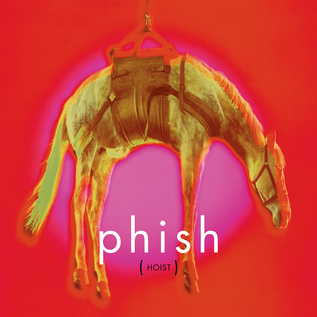
So what did we learn here? Hoist proved something I think Phish has been whispering since the start: you can lead a horse to water, but you can’t make him sink. Especially if he’s hoisted. This album was them trying to be professional human beings — and accidentally making one of their
weirdest, most perfect records.
Five tweezers out of five. That’s my score.
There’s a creative togetherness on this album you can’t deny, even when it’s ridiculous. These four are definitely birds of a feather.
Somewhere inside ‘Lifeboy’ and ‘Demand,’ they found something bigger than songs. They found a language of balance — between sincerity and inside jokes.
That’s what music is supposed to do, right? You hold up the mirror and laugh at your reflection.
So there’s only one thing left to cover, and that is the cover. The album is called Hoist, but for me, the message is clear. Together, musically, they are hung like a horse.