
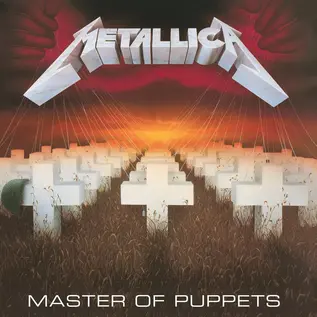
Metallica’s Master of Puppets, this is the sound of four guys in their early 20s, angry at everything, but mostly at time signatures. It’s fast, it’s ferocious, it’s flawless — well, except for Lars. But he’s there, clanking along like a toddler with a pot and spoon. So strap in, crank up your speakers, and prepare for an hour of existential rage, guitar heroics, and one Danish man trying to murder his crash cymbal collection.
Battery
Battery kicks off with that delicate little acoustic intro — like the calm before a bar fight. It’s got this Spanish-western flair, as if Clint Eastwood might crest a hill, squint, and mutter, “Who brought the distortion pedal?” Then boom — the “Chord of Doom” hits, the drums crash, and that pretty acoustic melody goes full electric like Dylan at Monterey. Except this time, everyone’s thrilled about it.
Then, we’re off to the races at 300 miles an hour. The band locks into a groove so tight it could crush a ribcage. Lars and Hetfield sync up like they’ve both been possessed by the same caffeine demon — though Lars is still the M. Night Shyamalan of drums, full of twists, none of them good.
Kirk Hammett comes roaring in, wah pedal screaming for mercy. He’s not just playing solos — he’s exorcising them. Say what you will about Metallica, but Kirk always knows when to turn it on.
And through it all, the song just pummels forward — pure aggression, pure obsession, pure speed. Even I have to admit: the double bass at the end from our favorite Danish Drum Gremlin? It’s pretty damn good.
Master of Puppets
The title track opens with that legendary riff — the one that basically became the national anthem of angry teenagers everywhere. It’s big, mean, and smarter than it has any right to be. Every chug and stutter-step hits like a steel boot. Metallica wasn’t just playing fast anymore — they were building architecture out of riffs.
We drop into the verse section, where James Hetfield starts barking philosophy like a beer-fueled Nietzsche. The song’s full of clever breaks, rhythmic switch-ups, and moments that scream, “Yeah, we practice.” There’s a reason this is the biggest-selling metal album of all time — it’s a masterclass in focus, fury, and perfectly channeled chaos.
Then comes that slowed-down, haunting echo:
“Master, master, masssterrr, maaaasssterrr…”
It’s like Satan got a loop pedal. And then — just when you think it’s all doom — the music blooms into this gorgeous, soaring solo. Kirk is painting in light, Lars is busy ruining it with 37 unnecessary cymbal crashes. But, maybe it's like a yin and yang thing where they are trying to balance each other out.
We swing through another tempo change, another riff labyrinth, another sermon from Pastor Hetfield. The whole band sounds on fire — or at least standing very close to it. There’s another short, blistering solo that somehow makes your blood pressure rise and your eyes tear up.
This song takes more left turns than a drunk Tesla, and every one of them lands. By the end, they’ve found the secret formula to heavy rock: play like your instruments wronged you, and make sure the drummer almost keeps up.
The Thing That Should Not Be
We ease back into cinematic territory here — that acoustic guitar from Battery creeps back in like a dusty gunslinger with unfinished business. It’s got that same Spanish flair, strumming away like it’s about to order a whiskey and start a duel. Then, suddenly, the earth splits open, and that sludge-heavy riff drops like a building collapsing in slow motion.
The rhythm is lurching, off-kilter, and absolutely perfect. But then we’ve got Lars Von Crashenstein doing his thing — which, apparently, is hitting every piece of his drum kit at once, just to make sure they’re all still there. It’s like he’s getting paid per cymbal crash. Big ones, little ones, sideways ones — this is Crash Course!
Then Kirk — the eternal voice of reason in this thunderstorm — steps up with a solo that whines, bends, and shreds. There’s a middle bridge that gives off Whole Lotta Love vibes, the part where it sounds like Robert Planet is trying to hold back a sneeze, we get that, but it's way cooler with Kirk and a whammy bar.
We swing back into that thick, groaning riff, where Hetfield’s voice sounds like a man trying to fight a bear.. It’s dark, heavy, and crawling with menace — like Black Sabbath’s evil twin. And as the last notes fade, Lars the Fill Reaper gives us a goodbye crash.
Welcome Home (Sanitarium)
Finally, a breather — well, kind of. The intro is beautiful, with classical-style guitar and delicate harmonics ringing like distant wind chimes in a psych ward. It’s calm, it’s pretty… and you know it won’t stay that way long.
Hetfield’s vocals are controlled, restrained — and for a moment, you think, “Hey, maybe this is a little breather of a song, but then, right around the line ‘Can’t they see that’s why my brain says rage?’ everything detonates.
Suddenly, the calm turns into chaos, the verse gives way to full-blown fury, and we’re reminded that Metallica doesn’t really do gentle. The chorus thunders in, all power chords and righteous anger, before pulling back again to let the song breathe — just long enough for Kirk to rip another blistering solo that feels like sunlight through barbed wire.
By the halfway point, things get heavy again — that signature “chuga-chuga” guitar kicks in and James is screaming like he’s trying to escape his own skull. Lars actually dials it back for a bit, which is a miracle worth noting in any religion.. The finale hits with that big Vegas ending — fireworks, fire, and full collapse. And then we’re off to war.
Disposable Heroes
This one sounds like it could’ve been a lost track from Ride the Lightning — and I mean that as a compliment. It’s got that early Metallica ferocity, like they were still fueled by cheap beer, anger, and the haunting memory of trying to keep up with Dave Mustaine.
The riff is classic thrash, all down-picking and clenched fists. The verse barrels forward with mechanical precision, but it’s got that raw, hungry energy that sets it apart. And then there’s Lars — Count Crashula — filling every gap with unnecessary flourishes like he’s afraid of silence.
What’s wild is how complex the arrangements are — time changes, stop-start transitions, and riffs stacked like a Jenga tower.. This is Metallica at full gallop, writing songs that sound like war machines learning Rush.
And let’s talk about this era for a second — because back then, metal had range. You had Iron Maiden writing nine-minute operas about ancient mariners. You had Megadeth doing calculus in riff form. And across the aisle, you had Poison and Bon Jovi fogging up the entire record store with Aqua Net. You could literally see the hairspray hovering over that section.
Disposable Heroes? This is the real deal. Aggressive, intelligent, tightly played chaos that punches you in the face and then apologizes for how good it felt. The cassettes may have melted in your car, but this track alone made it all worth it.
Oh, what a blessing and a curse cassettes were, though! Remember taping over the little hole so you could record over that shitty Nelson tape you stole from your sister? Or how sometimes a tape deck would just vomit out all of the tape. Just spew it right out onto the ground. Cassettes would melt, warp, get stuck, break... but, you could tape Duran Duran off the radio, goddamnit!
Leper Messiah
We’re back in the pit with Leper Messiah — and right out of the gate it’s heavy, simple, and mean, before exploding into that signature chugga-chugga that sounds like an 18-wheeler downshifting on its way to hell. Cliff sneaks in underneath it all with this slippery, melodic bass line, a nice reward for those who listen more closely.
But of course, Kick Drum Kardashian is behind the kit — famous for the drama, not the talent — and he’s filling up every inch of space with cymbal crashes like a toddler playing with the blinds. He’s pounding, plodding, crashing, flipping, flopping — I swear, the man plays drums like they downloaded his songs illegally.
His chaos gives the track this unpredictable tension that somehow makes it better, I guess. Hetfield’s vocals are sneering, sharp, full of religious venom, and the whole thing moves like a freight train with loose bolts. You can hear Cliff anchoring the madness, his tone so fat it’s practically three-dimensional. Just when you think it’s over, Metallica hits you with a fake-out ending — because of course they do. Nothing says “we’re artists” like making your fans check if their stereo broke.
Orion
Now this… this is where Metallica proves they’re not just angry guys with guitars — they’re angry musicians. “Orion” is eight and a half minutes of instrumental perfection, the kind of track that makes you stare off into space and wonder if you’ve been underestimating these dudes.
It starts with this fuzzy, distorted bassline from Cliff Burton that rolls in like fog — thick, heavy, and impossible to ignore. Lars actually behaves himself here, laying down a steady pulse that gives James and Kirk room to breathe. When the guitars come in with those unison riffs, it’s pure metal ballet — violent, graceful, and hypnotic all at once.
Then the glorious middle section — a breakdown that somehow sounds both cosmic and deeply human. Cliff takes over with that looping, melodic bass theme, and Kirk lays down a solo so beautiful it could make Kanye West feel something. Hetfield joins in on the melody and suddenly it’s not just music anymore — it’s storytelling, emotion, tension, and release.
For once, Lars McTempo keeps it tasteful, letting the song swell and breathe. As the music climbs back toward its finale, Kirk delivers one more solo because it’s contractually required that he gets two full solos each song, and the band closes it out in a swirl of fuzz, fury, and feeling. “Orion” is the soul of Master of Puppets.
Damage, Inc.
And then, chaos. “Damage, Inc.” kicks off with that eerie, reversed-guitar intro — all whale sounds and apocalyptic reverb — before detonating into pure thrash mayhem. It’s fast, mean, and tighter than a spandex jumpsuit at a Warrant concert.
This is the moment where all the themes of the album — control, destruction, madness — get jammed into a single track and played at warp speed. The riffs are razor-sharp, the stops are surgical, and Hetfield sounds absolutely unhinged. You can practically see the spit flying into the mic.
Lars, to his credit, is locked in with James here. Cliff’s bass is holding everything together, and Kirk’s solo is a full-blown DMT experience. Every note feels like it’s being ripped out of him by demons. The whole song feels like it’s on the verge of explosion — and that’s what makes it brilliant.
By the time it ends, you’re exhausted, exhilarated, and pretty sure you just survived something.
Wrap-Up
Master of Puppets isn’t just an album — it’s a fucking monument. It’s the sound of a band at their absolute creative peak, pulling every idea, emotion, and riff from their souls and slamming it into tape. It’s beautiful chaos — a screaming, soaring, crashing masterpiece that redefined what metal could be.
Sure, Lars hits everything like a mouthy girlfriend, and yes, Kirk may have personally melted every wah pedal in existence. But together with James and Cliff, they created something untouchable. The writing, the arrangements, the ambition — it’s all next-level.
This album didn’t just change Metallica — it changed metal itself. It’s smart, aggressive, and fearless. And even with all the crashes, clangs, and ego wars, it stands tall as one of the greatest heavy records ever made.
Master of Puppets is an album that grabs you by the throat and makes you remember why guitars should be loud, drums should be angry, and bass players should always, always be named Cliff.