
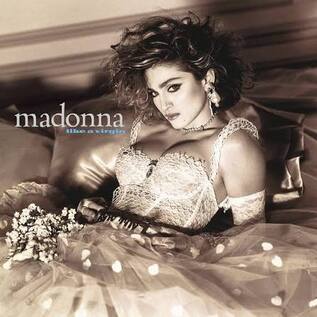
Madonna's second album, *Like a Virgin*, was massive in 1984. The album was produced by Nile Rodgers, the legendary guitarist and producer from Chic, who also plays guitar and keyboards throughout the record. Chic bassist Bernard Edwards and drummer Tony Thompson provide the live rhythm section on several tracks, while the remaining songs lean heavily on LinnDrums, synth bass, and the finest plastic electronic wizardry 1984 had to offer.
For anyone unfamiliar with Chic, they dominated the '70s and '80s with hits like "Le Freak," "Dance, Dance, Dance," and "Good Times." They also spent much of their career functioning as a backing band for some of the biggest names in music, including Diana Ross, Sister Sledge, Carly Simon, Mick Jagger, The Power Station, and Madonna.
That combination of Nile Rodgers, Chic's rhythm section, and Madonna's rapidly expanding pop empire makes *Like a Virgin* an interesting snapshot of mid-'80s pop music.
It is also a remarkably polished, glossy, heavily produced record—one that occasionally sounds less like a band playing music and more like a multi-million-dollar Pepsi commercial that accidentally got pressed onto vinyl.
## "Material Girl"
"Material Girl" kicks off with the quintessential 1984 pounding drum sound—the kind Robert Palmer and every other act on MTV were abusing at the time—over the requisite synth pile-up.
But credit where it's due: there's a solid groove here.
Madonna comes in with a vocal delivery that sounds shockingly like Dolly Parton. I can genuinely picture this track appearing in a 1978 Dolly movie like *9 to 5*.
She sings about living in a material world, which has only gotten progressively more terrifying as time has gone on. Has it always been like this? Did cavemen fight over who had the biggest collection of shiny rocks? Did cavewomen only date the guys with top-tier granite?
As the groove continues, her vocals get a little whinier and quirky keyboards pop up all over the mix. This gives off serious Cyndi Lauper vibes. Lauper's *She's So Unusual* had been released the previous year, and Madonna was very obviously going after some of that same market.
And for my money, Cyndi's "Money Changes Everything" completely slaps this around the room.
Watching Madonna try to sell consumerism as a fun personality trait makes me want to puke. It's the anthem for every person who ever dumped someone because their car had hand-crank windows. Cyndi sang about money ruining humanity; Madonna sang about using men as human ATM machines.
It's trash, and we all know it.
## "Angel"
"Angel" starts off danceable and funky—standard, pulsing '80s club music.
Madonna's vocals here are weirdly low-energy, sounding like she was pitch-shifted down in the mix, especially after the higher-register Dolly tone on the previous track.
This is prime '80s montage music, but the lyrics are physically painful: she sings, *"The only way this makes sense is if you're an angel."*
Yuck.
She tries to inject some oomph near the end, but it's too late. The song had already lost me.
Nile Rodgers plays some nice rhythm guitar throughout, though.
Compared with Cyndi Lauper's "Girls Just Want to Have Fun," there's really no contest. "Angel" is so utterly forgettable it feels like studio elevator music designed to keep cocaine addicts calm between takes.
You could play this in a dentist's waiting room and the patients wouldn't even realize they were being sedated.
It's a complete waste of Nile Rodgers' wrist action, and everyone involved should apologize to their ancestors.
## "Like a Virgin"
Everyone knows this one, but the production is worth revisiting.
Chic is back in the building with Tony Thompson and Bernard Edwards pounding out those massive Power Station-style beats. Madonna pulls out the sped-up Dolly voice again, and the lyrics remain thoroughly vacant.
The track fades with Madonna purring and asking, *"Can't you feel my heartbeat for the very first time?"*
That's a really fucking young virgin, by the way.
But I digress.
The third track on Cyndi Lauper's *She's So Unusual* is her cover of Prince's "When You Were Mine." Prince is my favorite musician of all time, and Cyndi's version is brilliant.
Madonna doesn't stand a chance.
"Like a Virgin" only became the enormous cultural phenomenon it did partly because of the music video and the controversy surrounding it. Musically, it's a fairly straightforward pop song wrapped in an enormous cultural package.
Without the controversy, you're left with a glorified nursery rhyme for adults who read at a third-grade level.
One final thought: without this song, we wouldn't have "Like a Surgeon" by Weird Al Yankovic, and that's not a world I'd want to live in.
## "Over and Over"
"Over and Over" opens like the background music playing in a training video for new hires at OfficeMax.
It is completely plastic and relentlessly repetitive.
She sings, *"I get up again over and over,"* which inspires absolutely no one.
Nile plays a little guitar here. This review is fast turning into a game of *Where's Waldo?* as I hunt for Nile's guitar on each track.
"Over and Over" flops around desperately trying to pretend it isn't filler, but not very successfully. It feels specifically written for an '80s teen movie.
There are essentially zero redeeming qualities here.
Compared with "Time After Time" on *She's So Unusual*, the songs actually share a similar theme, except "Time After Time" is an actual masterpiece.
It's so much better than "Over and Over" that Cyndi Lauper almost deserves two points.
Almost.
## "Love Don't Live Here Anymore"
The synths and bass across this whole album are completely overpowering.
Even on a track like this, with the actual Chic guys playing, the keyboard synth bass is deafeningly loud.
Lyrically, though, this is the first song on the record that feels like it has a soul.
When Madonna sings about the vacancy where love used to be, it actually sounds convincing.
Eventually, the synths get turned down a notch, allowing the live-band vibe to breathe.
I'm not a ballad guy, but this feels human inside a giant can of 1980s computer music.
The pace slows down, Madonna displays real range, and her voice sounds full of life.
It's a genuinely good track.
And then there's Cyndi Lauper's "She Bop."
Poor Madonna doesn't stand a chance against a catchy, world-conquering anthem about self-pleasure.
It's almost tragic that her single decent vocal performance on the entire album gets completely steamrolled by Cyndi singing about cranking one out in her bedroom.
Madonna tried to give us genuine heartbreak, but Cyndi gave the world an indestructible pop masterpiece about self-love.
Read the room, Madge—melancholy loses to masturbation every single day of the week.
Still, "Love Don't Live Here Anymore" is the best song on *Like a Virgin* so far.
## "Dress You Up"
There's decent use of the LinnDrum here, but the overall beat feels shallow and thin, giving off heavy *Miami Vice* soundtrack vibes.
Nile saves the day by adding some slick guitar work to the chorus.
I actually like Madonna's vocal delivery here, especially in the choruses. She sounds confident and is finally projecting some real energy.
Nile even lays down a great, screaming guitar solo, and the vocal textures in the breakdown section are surprisingly cool.
The lyrics, though:
*"I'm gonna dress you up in my love."*
What does that even mean?
Are we talking about a velvet jumpsuit or an uncomfortable rash?
Against "All Through the Night" on Cyndi's record, though, Cyndi takes it again.
## "Shoo-Bee-Doo"
Another ballad, starting off with some lounge-lizard piano and strings before the Chic guys step in to lay down a warm, alive-feeling beat.
Don't get me wrong—it isn't revolutionary, but having a human rhythm section holding down a groove for Madonna and her synth army feels like a breath of fresh air compared with the programmed tracks.
Lyrically, though, this is sugar-pop of all the worst kinds.
And "Shoo-Bee-Doo"?
Really?
That was the best title they could cook up?
The track tries to pick up steam near the end, but it just ends up getting louder and conveying even less substance.
Against "Witness" on *She's So Unusual*, there is no contest.
"Witness" takes it.
## "Pretender"
Another over-synthesized, throbbing heap of forgettable music.
Falling for a pretender is a decent concept for a pop song, but it deserved drastically better music than this.
Production-wise, it feels like they were desperately aiming for that gated-reverb Phil Collins sound.
I've also realized I prefer Madonna's higher-pitched Dolly Parton impersonation over the lower register she attempts on tracks like this.
Against Cyndi Lauper, this is the track "He's So Unusual," which is really just a short vintage intro for the next song.
So Madonna gets a charity point.
Giving Madonna a point here feels like giving a participation trophy to a kid who threw up on the field during Little League.
"Pretender" is so aggressively mediocre it's practically beige music.
It's a Phil Collins knock-off minus the drum chops, the passion, or the budget to make it sound believable.
## "Stay"
The album closer kicks in with a throbbing '80s keyboard shuffle.
Using a song called "Stay" to close out a record is clever. I'll give her that.
Unfortunately, the synths have long overstayed their welcome, her lower vocal register sounds exhausted, and I'm more than ready for this album to end.
The song seems to be about trying to restart a difficult relationship, and the music is just tired.
By the time this track finally sputters to a halt, you feel like you've been trapped in a neon-lit basement with a malfunctioning Casio keyboard for forty minutes.
It doesn't end.
It just gives up.
"Stay"?
No thanks, Madge. I'm getting the hell out of here before another LinnDrum preset triggers my fight-or-flight response.
Against Cyndi Lauper's "Yeah Yeah," again there's no contest. Cyndi's new-wave track is plastic and cheesy and self-aware, just as it should be.
## The Wrap-Up
*Like a Virgin* was a massive cultural phenomenon, but there was vastly superior music sitting right next to it on the shelves.
The album is a fascinating example of how marketing, money, production, and cultural momentum can become just as important to a record's success as the actual music.
There is also a strange split personality running through the album.
On one side, you've got Nile Rodgers, Bernard Edwards, Tony Thompson, and the rest of the Chic-associated musicians bringing real musicianship and grooves to several tracks.
On the other, you've got LinnDrums, synth bass, layers of electronic production, and an army of keyboards that frequently overwhelm everything else.
The result is essentially half a Chic record trapped inside a Tandy computer.
There is a redeeming purpose for the whole thing, though: *Like a Virgin* works surprisingly well as a drinking game.
Every time you hear Nile Rodgers playing guitar, take a drink.
By the time you reach "Stay," you'll probably be drunk enough that you won't notice the album isn't nearly as good as everyone claimed it was.
**Final Rating: 2 out of 5 Lace Gloves**
*Like a Virgin* is an important pop record and an enormous cultural artifact, but importance and quality aren't necessarily the same thing.
For me, the more interesting comparison is what was happening alongside it. Cyndi Lauper's *She's So Unusual* came out around the same time and demonstrates just how much more inventive, colorful, and musically interesting mainstream pop could be in 1984.
Madonna may have won the cultural battle.
But on this particular musical battlefield, Cyndi brought a much bigger gun.