
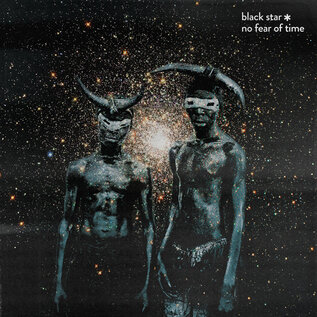
One of the most anticipated, elusive, and genuinely profound hip-hop returns in history came from the rap duo of Yasiin Bey—formerly Mos Def—and Talib Kweli, collectively known as Black Star, with their long-awaited follow-up album, *No Fear of Time*.
Twenty-four years is a long time between records.
To put that into perspective, when their debut album dropped in 1998, people were still worried about the Y2K bug, AOL was filling up trash dumps with CDs, and you had to rewind a VHS tape before returning it to Blockbuster so you didn't get charged a dollar.
Fast-forward nearly a quarter of a century, and out of nowhere, they dropped this fresh masterpiece.
Talib Kweli mentioned in an interview that the recording process for this album was completely guerrilla-style. It wasn't laid down in some multi-million-dollar studio in Los Angeles with an army of corporate executives hanging around the mixing board.
They recorded the album over a span of four years in random hotel rooms, backstage dressing rooms, and side suites while on the road with Dave Chappelle. They were literally writing verses between stand-up sets and ducking into hotel closets with portable microphones to capture the magic.
Usually, I like to make some sharp jokes, roast a singer for sounding like a stray cat, and generally get my kicks at the expense of famous artists, terrible lyrics, and obviously your mom.
But this album hit me completely differently.
*No Fear of Time* is serious, high-level art. It's heavy, intelligent, and delivered with absolute master-level precision by Kweli and Bey, all riding on the legendary, crate-digging production of Madlib.
When I put this record on for the first time, I didn't feel like poking fun. I felt like I was knee-deep in alligators and completely out of pants...
Just like your mom.
See? I had to get at least one in there.
But seriously, *No Fear of Time* is a masterclass.
## "O.G."
The album opens with "O.G.," launching into a slow, hypnotic, head-nodding beat as Yasiin Bey steps up in his classic half-mumble, half-sly Brooklyn style to set the stage.
The chord progression floating underneath him is moving and complex. Madlib uses unpredictable timing shifts and jazz-infused chord choices that shouldn't work, but somehow slide into the groove effortlessly.
Instead of relying on the slick, quantized, robotic drum loops that dominate modern trap radio, Madlib layers in raw samples of live drums and warm basslines that make the track feel alive, dusty, and organic.
It sounds like a vinyl record you found buried in the basement at your uncle's house.
And then Bey hits us with that chorus:
*"I want to thank you for helping me reach the understanding, that time is relative and the truth is everlasting!"*
It's gorgeous.
It's melodic, thoughtful, and immediately sets the philosophical tone for the whole record.
Kweli takes over the second verse, and the contrast is phenomenal. Where Yasiin is fluid and conversational, Kweli's flow is tight, tactical, sharp, and relentless.
Both Stars are delivering essentially the same underlying message here, and it is the ultimate thesis for two guys dropping a second album 24 years after their first.
They're basically telling us: We're older, we're smarter, we've been through the meat grinder of the music industry, and we've survived some real life. But now they get it.
The perspective has shifted.
The ego is gone.
And it's all good.
It's a great message, paired with a stunning opening track.
## "So Be It"
Next up is "So Be It," and Madlib cooks up this menacing, gritty beat that sounds like it was ripped straight out of a 1970s gritty New York police drama.
You can practically see the steam rising out of the Manhattan manholes and the yellow cabs zooming down 42nd Street.
Yasiin is completely on top of this first verse.
I'm not sure there's a traditional linear narrative here as much as a rhythmic, rapid-fire recitation of vivid imagery—very much in the tradition of prime Bob Dylan or William S. Burroughs.
Bey absolutely slays this from start to finish.
It's a masterclass in rap precision, breath control, and rhythmic feel. All the while, that heavy, brooding beat cranks along in the background, with sudden bursts of vintage wind instruments sneaking into the mix to add even more cinematic menace to the track.
Talib Kweli steps up for the second verse and keeps that momentum rolling.
He unleashes a stream of striking images and dense thoughts that somehow construct a cohesive story purely through feeling and atmospheric descriptions.
And that Madlib beat just refuses to quit. It loops and loops, locking you into a trance.
Two songs in, and this record feels fresh, tight, uncompromising, and totally original.
Give it up for Madlib. His production is giving these two lyricists the perfect canvas to paint on.
## "Sweetheart. Sweethard. Sweetodd"
Then we move into "Sweetheart. Sweethard. Sweetodd," where Kweli steps up first over a track that plays out like a futuristic, avant-garde ballad.
Madlib samples real acoustic instrumentation and layers it into a piece of cosmic R&B.
You can hear echoes of vintage Motown in the faded background harmonies, grounded by a deep, warm bassline that feels like it was plucked straight out of a classic '90s R&B hit.
But then the production touches are so slick and modern that they make your skin tingle.
It's an incredible fusion of eras and aesthetics.
When Bey comes in for his verse, the broader narrative of the album becomes even clearer.
This song lays out everything they've learned over two decades about love, human connection, maturity, and the messy realities of relationships and sex.
And what a brilliant title to sum up the arc of romance: "Sweetheart" when it begins, "Sweethard" when life gets tough, and "Sweetodd" when you look back on the whole strange trip.
## "My Favorite Band"
That leads us into "My Favorite Band," where the instrumentation feels like a classic Temptations record slowed down to two-thirds speed, giving every note a heavy, deliberate weight.
Bey delivers a verse about personal growth, perspective, and realizing that everything is fundamentally okay even when the world around you seems completely whacked out of its mind.
The level of focus these two possess on this record is staggering.
*No Fear of Time* isn't just a collection of songs slapped together to satisfy a streaming algorithm. It is a true, cohesive concept album.
Every track approaches that core concept of time, mortality, and truth from a slightly different angle.
Bey lays it down plain and simple here:
Enjoy the day, because right now is all you've actually got.
## "The Main Thing Is to Keep the Main Thing the Main Thing"
Now we get to perhaps the most important title on the entire album:
**"The Main Thing Is to Keep the Main Thing the Main Thing."**
Madlib dishes out another dark, menacing loop, and Yasiin steps to the mic sounding like he's freestyling straight from his soul about the absurd state of the modern world.
He touches on how everything in our lives has become automated, disposable, and instant. We live in a world where you can push a button on a glass screen to get artificial bird songs on demand.
He dissects the trap of modern consumerism, the endless cycle of superficial desires, and the spiritual exhaustion of the digital age.
It's sad, beautiful, and inspiring all at once.
We live in an era where everyone is perpetually distracted by outrage and notifications, and the song title hits you like a brick:
**The Main Thing Is to Keep the Main Thing the Main Thing.**
Bey says it best with a line that should be carved into stone:
*"Everything is not for sale."*
A lonely, looping piano line floats over a heavy bass drum, perfectly capturing the reflective mood.
Kweli joins in with his own string of dense, considered thoughts, addressing social concerns and offering spiritual answers to modern problems.
His flow is liquid smooth, bouncing right on top of the pocket with flawless timing.
And after everything has been laid bare and that dark, hypnotic loop has finally run its course, the track ends in the only natural way it possibly could.
The music cuts out completely.
The room goes silent.
And they say together:
*"Yikes."*
Perfect.
Just perfect.
## "Yonders"
Next is "Yonders," which kicks off with a sound snippet that feels like it was lifted from a classic Spaghetti Western, instantly shattered by the sound of gunfire.
Kweli takes the lead on this one, and it is a heavy, hard-hitting track.
He gets right to the heart of systemic issues—gentrification, cultural erasure, food deserts in disenfranchised neighborhoods, and profit-driven hospitals.
This is urgent, vital music that deserves to be heard by as wide an audience as possible.
But here's the wild thing about this release: when it dropped, you couldn't even buy it on iTunes or stream it on Spotify.
You could only listen to it if you subscribed to Luminary, a niche podcast network.
I actually went and checked out Luminary's platform, spent some time clicking around, maybe ten minutes or so, and realized they haven't put out much of anything new in a long time.
So if you're trying to stream this digitally, you better run over there and grab a free trial before they go the way of Napster and LimeWire.
Thankfully, a year later they put it out on vinyl and CD so people could hear it.
Anyway, Kweli's delivery on "Yonders" is conversational, brilliant, and incredibly moving.
The Boogeyman—Yasiin Bey—steps up to close out the second half with just as many thought-provoking observations, before the track slowly fades out on that haunting echo:
*Yonders... Yonders... Wanders...*
## "Supreme Alchemy"
That brings us to "Supreme Alchemy," which functions as the meta-story and creative blueprint of how *No Fear of Time* was actually brought into existence.
This isn't just another track in the sequencing; it's the conceptual glue holding two decades of radio silence together.
It explores the foundational ideas, the late-night philosophical conversations, and the sheer weight of life events that Bey and Kweli had to navigate over the twenty-four years since their debut.
Think about everything that happens in a quarter of a century.
Careers peak and valley. Personal loss stacks up. The world shifts beneath your feet. The music industry transmutes into a completely different beast.
"Supreme Alchemy" is about the literal and spiritual process of taking those raw, heavy life experiences and refining them into gold.
It's an exploration of how two master lyricists can step back into a room together and turn twenty-four years of emotional baggage into a singular, cohesive piece of art.
Madlib takes his production even deeper here, elevating the track from a standard beat into a living, breathing soundscape.
His mix is unpredictable, textured, and flat-out brilliant.
Instead of relying on a safe, repetitive loop, he keeps the listener on edge. Sudden drum fills glide in and out of nowhere, panning left to right.
Beneath the percussion, mellow electric-jazz organ chords float and shimmer, giving the track a warm, late-night atmosphere that feels both vintage and completely timeless.
Over this rich sonic backdrop, Kweli attacks his verses with raw, fiery passion.
His cadence is sharp and urgent, matching the complexity of Madlib's arrangement bar for bar.
He raps with the hunger of a newcomer paired with the absolute authority of a veteran who knows he has nothing left to prove to anyone.
When Bey slides into the space around him, the dynamic hits its peak.
It's an amazing contrast, showing exactly what happens when two elite minds operate on the same artistic wavelength.
They aren't just rapping.
They're demonstrating the exact alchemy promised in the title.
## "Freequency"
Then we hit "Freequency," featuring a guest verse from the legendary Black Thought of The Roots.
Mellow bass, sparse cymbals, and subtle ambient sound effects open the track before Black Thought steps up and crushes his verse.
The title here is incredibly apt. It's all about the frequency you choose to vibrate on in this life versus where you think you want to be.
Are you actually free just because a document or a politician says you are?
No.
You are only free when you live a life that is internally liberated—free of lies, free of baggage, free of unresolved trauma, and free of toxic desires.
Yasiin delivers a line that stopped me in my tracks:
*"Nobody makes it out alive... nobody ever really dies."*
I felt genuinely lighter after listening to this song.
The closing section of "Freequency" weaves in subtle musical and lyrical nods to earlier moments on the album, as Bey croons, *"waves all over the place,"* while the sound of real ocean waves crashes in the background.
As the track fades out into the water, it leaves you with a profound sense of peace.
## "No Fear of Time"
Finally, we arrive at the title track and album closer, "No Fear of Time."
The track opens with a heartbreaking audio story of a Black mother having her newborn child taken away, blending into snippets about systemic injustice and how little has changed over the decades.
Yet against all that heavy historical weight, the song delivers its core truth:
You must live with no fear of time, or you aren't truly living at all.
It is a heart-wrenching and gorgeous final statement.
It actually reminds me of a famous quote from that world-renowned culinary master, Chef from *South Park*, when he was standing in the middle of an unimaginable, apocalyptic turkey disaster.
He looked out at the chaos and said:
*"Every turkey dies, but not every turkey truly lives."*
And beneath the humor, that is the exact message of this album.
We are all turkeys, and we will all die.
But do you choose to live?
Madlib keeps the backdrop laid-back, vintage, and soulful, with lush horn lines sweeping in and out of the arrangement.
The song—and the album—closes with a spoken-word commentary on the deep cultural roots of hip-hop.
It leaves you with the unmistakable feeling that Black Star views music not simply as a product to be monetized, but as education, living culture, and a spiritual lens that can teach you how to see the world clearly.
I think that's a fucking great way to look at art.
## The Wrap-Up
Black Star made us wait 24 years for a follow-up record, and it turns out it was the exact amount of time they needed to create a masterpiece.
*No Fear of Time* is profound, beautiful, mature, and layered with so much musical and lyrical depth that you discover something new on every listen.
I've listened to it several times now, and it continues to reveal new details.
This is an album about time, mortality, truth, maturity, love, social injustice, consumerism, spirituality, and the simple act of being alive.
The production from Madlib gives Bey and Kweli an endlessly fascinating landscape to explore, while the two MCs sound completely comfortable in their respective styles.
There is no attempt to recreate 1998.
There is no desperate attempt to sound young.
Instead, *No Fear of Time* sounds like two artists who have lived another 24 years and have something meaningful to say about what they found along the way.
Honestly, this record deserves to be mentioned in the same conversation as all-time classics like Marvin Gaye's *What's Going On*, Sly and the Family Stone's *There's a Riot Goin' On*, and Stevie Wonder's *Songs in the Key of Life*.
I truly believe it is that important of an artistic statement.
**Final Rating: 5 out of 5 Black Stars**
Zero notes.
In fact, I'm not even sure I ever want another Black Star album after this.
If this is where they leave it, *No Fear of Time* stands as one of the most perfect, triumphant final statements in hip-hop—and possibly in music history.